By Zavian Thornell, iGaming Writer & Content Specialist. After years of writing about casino math and publishing peer-reviewed datasets, I built the tool I always wanted — a free, independent calculator lab where every number is backed by real probability theory.
Why I Built FairGameLab
I’ve spent the better part of a decade writing about house edges, provably fair algorithms, and the math behind casino games. The problem I kept running into was simple: players had no easy way to verify the numbers themselves. Casino sites publish RTP figures, but those are marketing claims. Academic papers have the math, but nobody reads a 40-page PDF before placing a C$10 bet on Aviator.
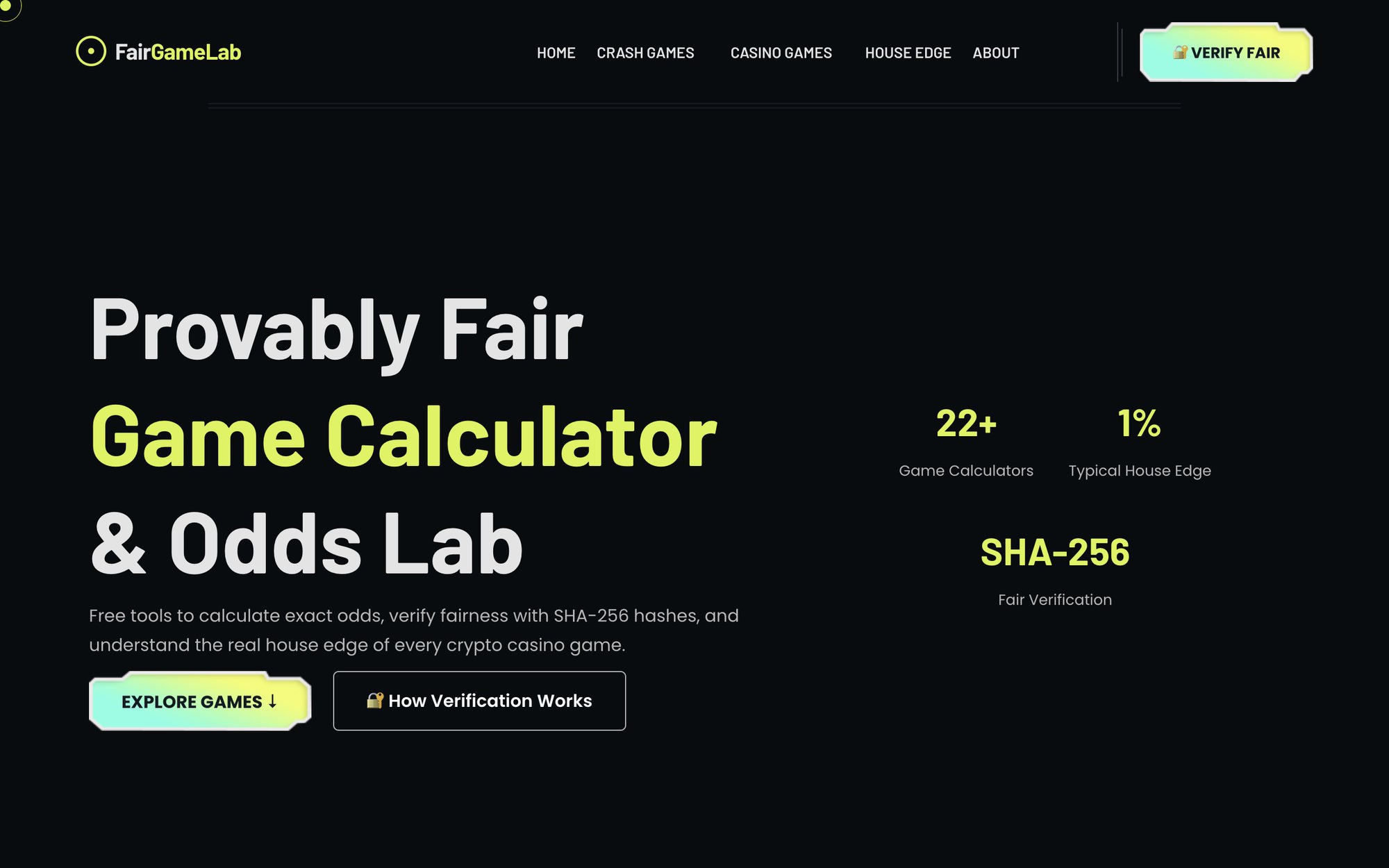
So I built FairGameLab — a free, independent calculator lab covering 22 casino and crash games. No affiliate links on calculator pages. No deposit buttons. Just math you can actually use.
What FairGameLab Does
The site gives you three things that are hard to find anywhere else in one place:
- Game-specific calculators. Enter your bet amount and game parameters — multiplier target, number of mines, dice win chance, Plinko rows — and get exact expected value, win probability, and house edge. Not estimates. Exact figures derived from the underlying probability distributions.
- Provably fair verification guide. A step-by-step breakdown of how HMAC-SHA256 cryptographic hashing works in practice, how to check any game result yourself, and what it actually proves (and what it doesn’t).
- House edge comparison tables. All 22 games side by side — RTP, house edge, volatility, max win multiplier — so you can compare before you play, not after you lose.
The 22 Games Covered
FairGameLab covers both major categories of crypto casino games:
- Crash Games (9): Crash, Aviator (Spribe), Spaceman (Pragmatic Play), Balloon, JetX (SmartSoft), Lucky Jet, Aviatrix, Chicken Road, and Limbo.
- Casino Games (13): Mines, Dice, Plinko, Dragon Tower, Diamonds, Keno, Hi-Lo, Coin Flip, Baccarat, Roulette, Wheel, Double, and Fortune Tiger.
Each game page has its own dedicated calculator with real-time stats, an odds table with every possible outcome, and a detailed guide explaining the math behind the numbers.
How the Math Works
Every calculator on FairGameLab is built on published probability models — not scraped from casino marketing pages. Here’s how the core engines work:
- Crash games use the formula P(survive) = 0.99 / multiplier. The house edge is baked into the 0.99 coefficient — a 1% edge on every round, regardless of your cashout target. The calculator shows you exact win probability and expected value at any multiplier.
- Mines uses sequential hypergeometric probability — each safe tile you reveal changes the odds for the next pick. The calculator tracks this dynamically as you adjust mine count and tiles revealed.
- Plinko follows a binomial distribution modified by the multiplier table. The number of rows and risk level determine the exact probability of landing in each slot.
- Keno uses hypergeometric distribution — drawing without replacement from an 80-number pool. The calculator shows exact probabilities for every possible match count.
- Baccarat is modeled on a full 8-deck shoe with proper commission rules. Banker, Player, and Tie probabilities calculated to six decimal places.
I’ve published four peer-reviewed datasets on Zenodo covering Video Poker RTP, Blackjack Monte Carlo simulations, Roulette betting systems, and Casino Bonus Expected Value. FairGameLab’s calculators are built on the same methodology.
Provably Fair: What It Actually Means
The term “provably fair” gets thrown around a lot in crypto gambling. Most players assume it means “the casino is fair.” It doesn’t. It means something narrower and more useful: you can mathematically verify that the outcome wasn’t changed after you placed your bet.
Here’s how it works in practice:
- Before you bet, the casino generates a server seed and gives you a hashed version of it (SHA-256). This locks the outcome.
- You provide (or accept) a client seed. Your seed combines with the server seed to produce the game result via HMAC-SHA256.
- After the round, the casino reveals the original server seed. You hash it yourself and compare — if the hashes match, the outcome was predetermined and tamper-proof.
FairGameLab’s provably fair guide walks through this process step by step, including the specific conversion formulas used by major providers like Stake, BC.Game, and Rollbit.
What FairGameLab Doesn’t Do
A few things worth stating clearly:
- It’s not a casino. You can’t play games or deposit money. It’s a calculator lab — a reference tool.
- It won’t help you “beat” the house. The math is the math. Every game has a built-in house edge, and no calculator changes that. What it does is show you exactly what that edge is, so you can make informed decisions.
- It’s not financial advice. Gambling is entertainment with a negative expected value. The calculators help you understand the cost of that entertainment before you spend it.
What’s Next
FairGameLab launched with 22 games, 16 calculator engines, and two hub guides. I’m planning to expand the coverage to include more provider-specific verification tools and additional game types as crypto casinos add them.
If you want to check the odds before you play, the house edge comparison table is the best place to start. If you want to understand the cryptographic side, start with the provably fair verification guide.
The tools are free, independent, and open to everyone. That’s the whole point.